
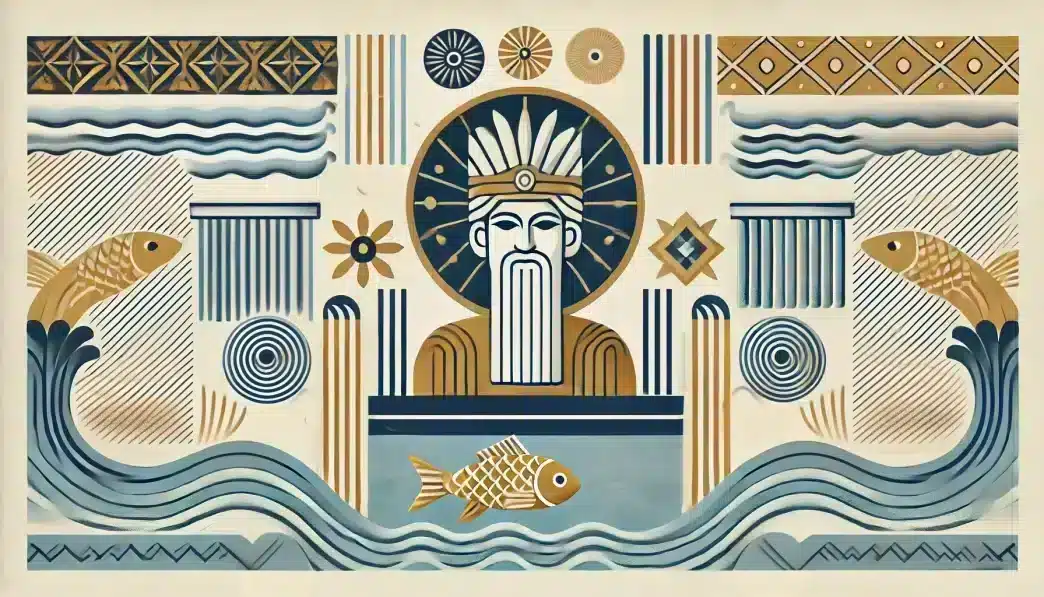
Enki or Ea
Enki, also known as Ea, is a key Mesopotamian god of water, wisdom, creation, and magic, vital in myths like the flood and civilization’s origins.
Enki, also known as Ea, is a key Mesopotamian god of water, wisdom, creation, and magic, vital in myths like the flood and civilization’s origins.

Discover the astronomical unit, the key distance measurement between Earth and the Sun, essential for understanding our solar system and space exploration.

Explore the characteristics, formation, and significance of planets in astronomy, including types of celestial bodies and the search for life beyond Earth.

Luonnotar, also known as Ilmatar, is the Finnish goddess of creation and nature, central to the Kalevala myth where she shapes the world from chaos.

Explore how gravity shapes our world, influences technology, and governs celestial motions. Understand its role from everyday life to the cosmos.

Explore the powerful stellar explosions known as supernovae, their causes, effects, and significance in the cosmos and our universe’s evolution.

A star is a celestial body emitting light and heat, symbolizing hope and inspiring scientific discovery. Learn how stars influence life and culture.

Explore T Tauri stars, young variable stars key to understanding star formation, stellar evolution, and planet formation in astronomy.

Accretion in astrophysics explains how small particles merge to form massive celestial bodies like stars, planets, and black holes through gravitational attraction.

Explore the fascinating world of exoplanets, their discovery methods, types, and the impact of their research on science and the search for extraterrestrial life.

Explore the giant-impact hypothesis explaining how the Moon formed from a massive collision between Earth and a Mars-sized body called Theia billions of years ago.

Hades, god of the underworld in Greek mythology, rules the realm of the dead with fairness and controls earthly wealth and judgment of souls.

Explore the formation and key characteristics of protoplanets, the early building blocks of planets that shape our solar system and support life.

Explore the 4.6 billion-year journey of the Solar System’s formation and evolution, from cosmic dust to planets and ongoing discoveries.

Explore the universe’s structure, age, and composition, from the Big Bang to dark matter and future cosmology discoveries. Understand cosmic evolution and common myths.

Explore the nebular hypothesis and how it explains the formation and evolution of our Solar System and other planetary systems in the universe.
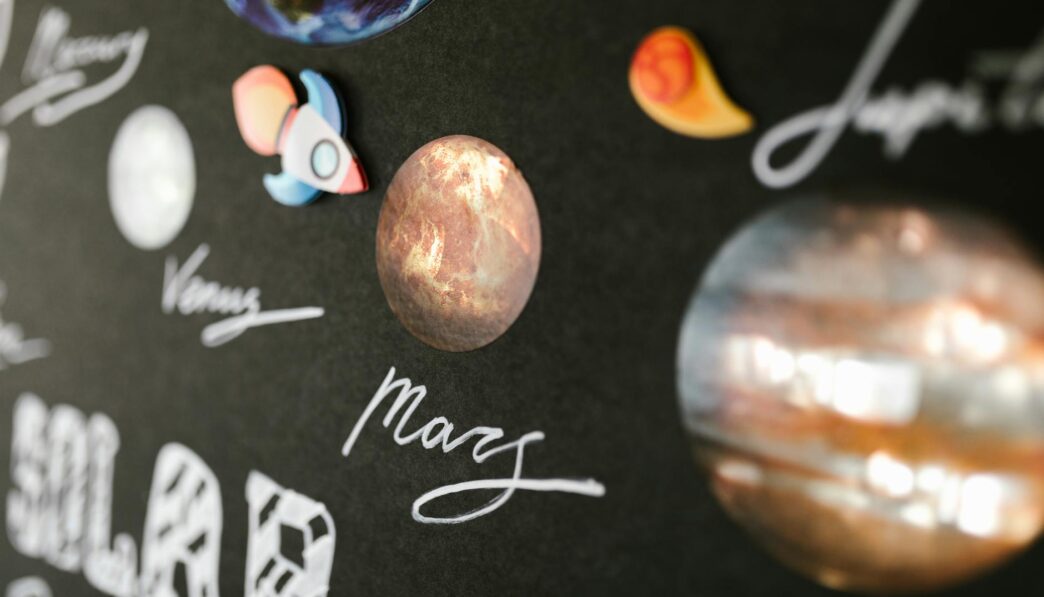
Explore the 4.6 billion-year formation and evolution of the solar system, from the solar nebula to planetary development and cosmic discoveries.