
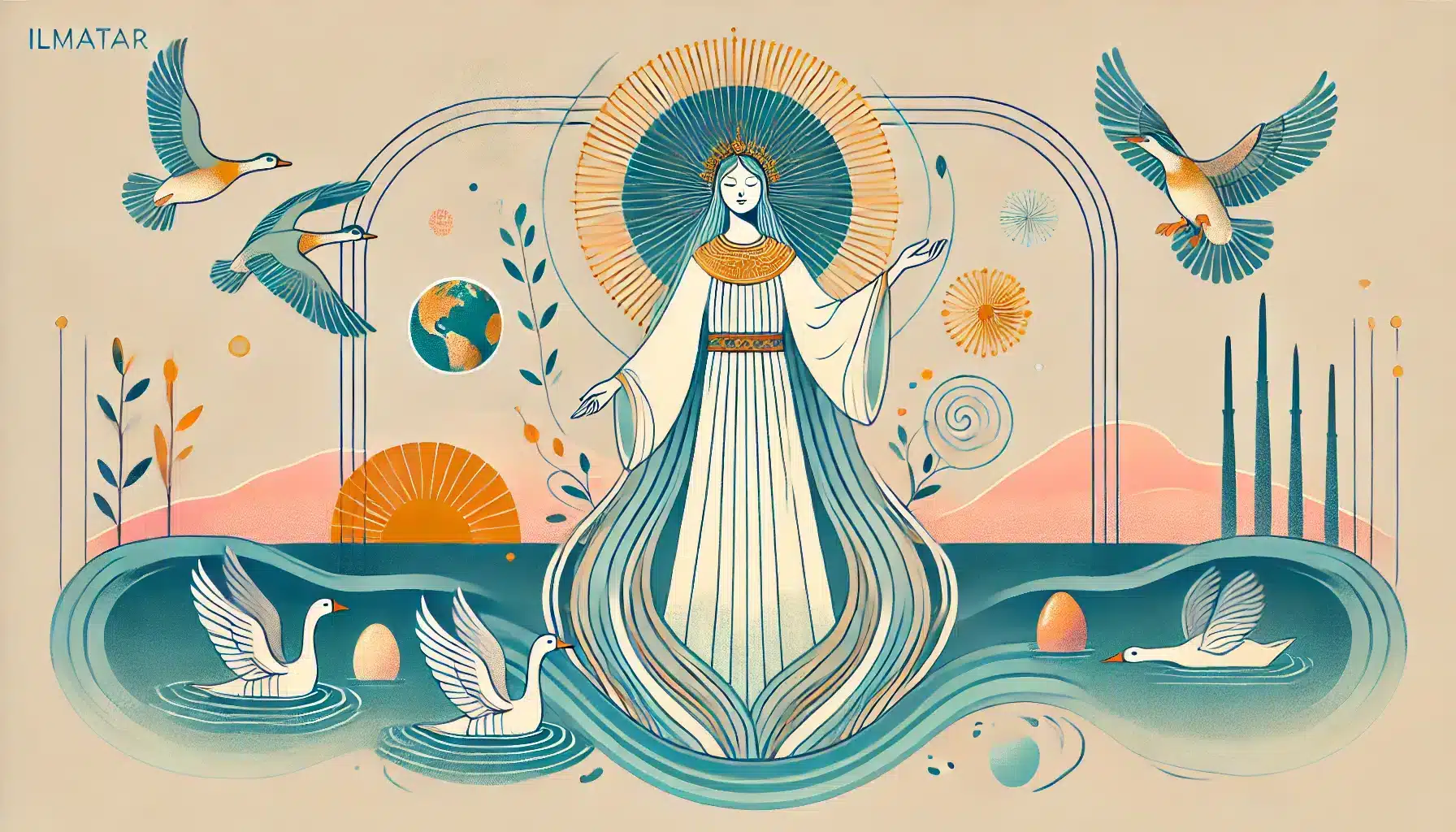
Luonnotar is one of the most significant figures in Finnish mythology, serving as the spirit of nature and the creator of the world. She is celebrated for her role in the Kalevala, Finland’s national epic, where her actions give shape to the universe. Her deep connection to the natural world and her creation of life symbolize her nurturing and transformative power.
Name: Luonnotar (also known as Ilmatar)
Role: Goddess of creation
Mythology: Finnish (Kalevala)
Domain: Creation, nature, and harmony
Family: Daughter of Ilma (Air), mother of Väinämöinen
Origin and Background
Luonnotar’s story begins in the celestial realms, where she exists as the daughter of Ilma, the personification of air. Lonely in her ethereal existence, she descends to the primal waters that cover the earth. For centuries, she floats in the vast expanse, contemplating her solitude. Eventually, her role in creation is sparked by the arrival of a waterfowl searching for a place to nest. The bird lays eggs on Luonnotar’s knee, and as she moves, the eggs tumble into the water and shatter. The fragments of these eggs become the earth, sky, sun, moon, and stars, bringing order to the chaos.
Appearance and Symbols
Luonnotar is often depicted as a serene, radiant maiden embodying the beauty and mystery of nature. Her symbols include:
- The sea, representing her time floating on the chaotic waters.
- The egg, symbolizing the origin of creation.
- Birds, particularly waterfowl, as they play a crucial role in her myth.
Powers and Abilities
As the goddess of creation, Luonnotar’s powers are deeply tied to the natural world. She is the architect of the earth and cosmos, shaping the physical realm from the fragments of chaos. Her powers also embody balance and harmony, ensuring the interconnectedness of all elements.
Unlike deities associated with war or destruction, Luonnotar’s influence is gentle, emphasizing the nurturing and transformative aspects of creation.
Personality and Traits
Luonnotar is patient and introspective, characteristics that define her long wait for the moment of creation. Her solitude in the waters reflects her thoughtful nature, while her eventual role as a creator highlights her transformative power. She is nurturing, bringing life and order to the universe without conflict or dominance.
Famous Myths
The most famous myth involving Luonnotar is the creation of the world. Floating on the primal waters, she becomes the site of a waterfowl’s nesting. The bird lays eggs on her knee, which fall into the sea and shatter. From these fragments, the earth, sky, and celestial bodies emerge. This story positions her as the mother of all creation.
Another myth centers on Luonnotar’s role as the mother of Väinämöinen, a central figure in Finnish folklore. Impregnated by the sea and the wind, she carries Väinämöinen for centuries before his birth. This tale symbolizes the birth of wisdom and knowledge into the world, as Väinämöinen becomes a wise sage and hero in the Kalevala.
A lesser-known myth ties Luonnotar to the Northern Lights. Some Finnish legends describe her as a celestial dancer whose movements with the wind create the vibrant colors of the aurora. This story underscores her harmonious relationship with nature and the cosmos.
Worship and Legacy
Though there is no evidence of formal worship of Luonnotar, she is a revered figure in Finnish cultural identity. Her creation myth reflects the Finnish people’s deep connection to nature and their respect for the balance of the natural world.
Her legacy lives on in art, literature, and music. Jean Sibelius, the renowned Finnish composer, immortalized her story in his symphonic poem Luonnotar. The goddess has also inspired modern environmental movements and feminist interpretations, highlighting her role as a powerful, nurturing force.
Conclusion
Luonnotar is a testament to the Finnish reverence for nature and creation. Her story of patience and harmony reminds us of the beauty in transformation and the interconnectedness of all life. In a world increasingly disconnected from nature, her legacy offers a timeless message: to respect and cherish the natural forces that shape our existence.
Read more
Why do you keep falling for the same type?
Read the article Lovemaps: the hidden blueprint of our love.
Did you not find what you were looking for? Let me help you find more.
