
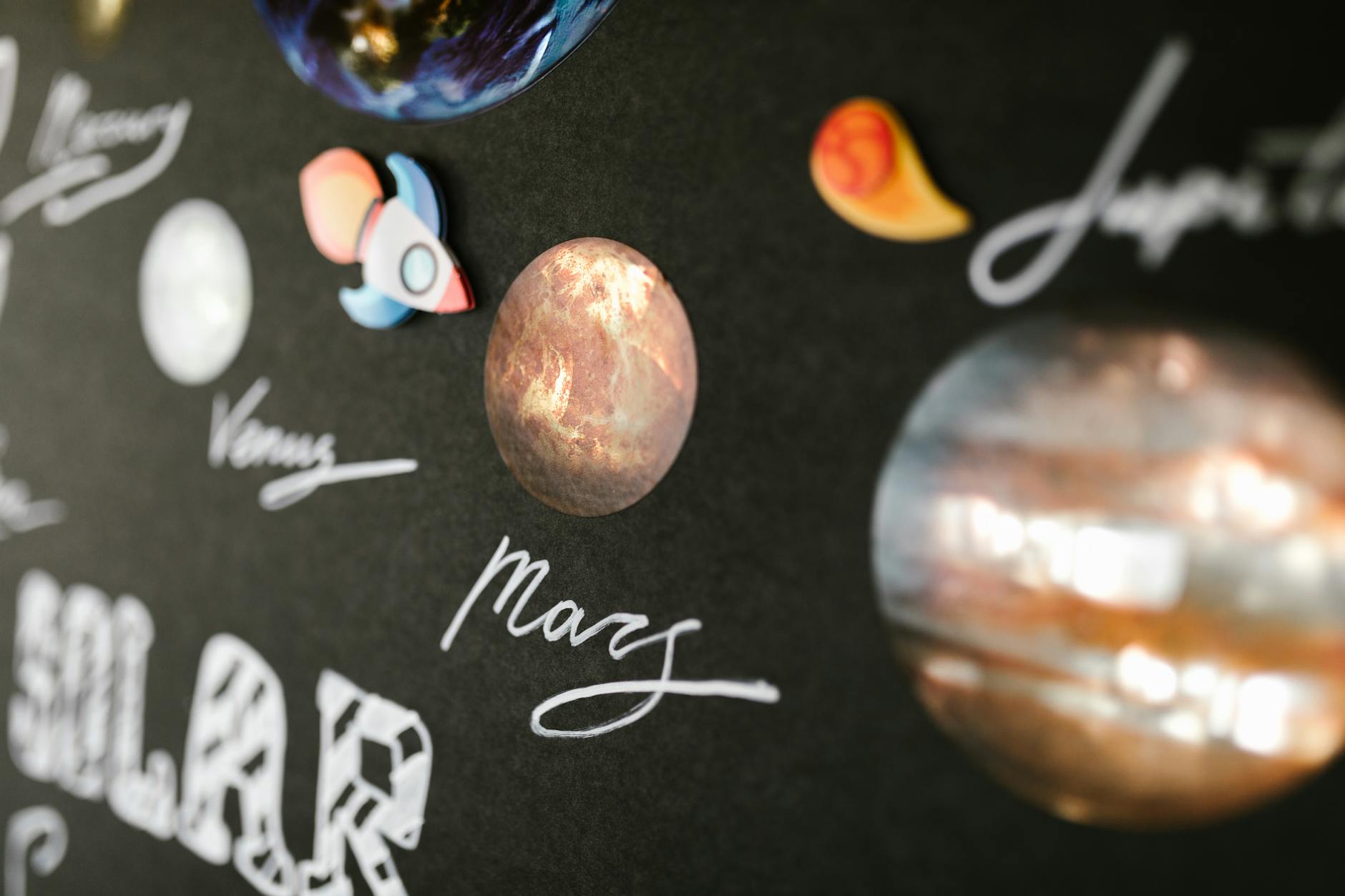
Formation and Evolution of the Solar System Over 4.6 Billion Years
Unlocking the Secrets of Our Cosmic Neighborhood
The solar system, a vast expanse of celestial bodies, has fascinated humanity for centuries. Understanding its formation and evolution is crucial to grasping our place in the universe. The solar system formed approximately 4.6 billion years ago from a rotating disk of gas and dust, known as the solar nebula. As this molecular cloud collapsed under its own gravity, it began to spin and flatten into a disk, leading to the formation of the Sun at its center.
The Building Blocks of Planets
Planets are not random collections of matter; they are built from smaller components called planetesimals. These tiny bodies collided and merged over millions of years to form larger objects. For instance, Earth and its neighboring planets likely formed from countless impacts that contributed to their mass and structure. The inner planets,Mercury, Venus, Earth, and Mars,are rocky due to their proximity to the Sun’s intense heat, while the outer planets,Jupiter, Saturn, Uranus, and Neptune,formed in cooler regions with more abundant ice and gas.
How It Works: The Dance of Gravity and Motion
The formation of the solar system is a remarkable interplay of gravity and motion. As materials in the solar nebula collapsed under gravity, they began to spin faster, a principle known as conservation of angular momentum. This led to the formation of a flattened disk where most material ended up in the center (the Sun), while other materials clumped together to form planets and other celestial bodies. For example, Jupiter’s immense gravity influenced the orbits of nearby asteroids and prevented them from forming into another planet.
Common Myths About Our Solar System
- Myth: The planets orbit in perfect circles.
- Fact: Planetary orbits are elliptical, meaning they are oval-shaped.
- Myth: All planets rotate on their axis in the same direction.
- Fact: Venus rotates retrograde compared to most planets.
The Life Cycle of Celestial Bodies
Celestial bodies undergo significant changes throughout their existence. Stars like our Sun will eventually exhaust their nuclear fuel and evolve into red giants before shedding their outer layers to become white dwarfs. This process enriches the surrounding space with heavier elements created during stellar nucleosynthesis, which can later contribute to new star systems or even life on planets. Elements such as carbon and oxygen formed in stars are essential for life as we know it.
Exploring Beyond Our Backyard
The exploration of our solar system has yielded groundbreaking discoveries. Missions like NASA’s Voyager probes have traveled beyond the planetary realm, providing invaluable data about outer planets and their moons. Similarly, missions like Mars rovers have revealed evidence of past water flows on Mars, suggesting that it may have once supported life.
The Role of Technology in Cosmic Discovery
Advancements in technology have revolutionized our understanding of the universe. Telescopes equipped with powerful sensors allow astronomers to observe distant galaxies and exoplanets with unprecedented clarity. Spacecraft equipped with sophisticated instruments can analyze planetary atmospheres and surface compositions directly. For instance, the Hubble Space Telescope has captured stunning images of distant nebulae and galaxies, expanding our knowledge of cosmic evolution.
A Glimpse into the Unknown
Despite our advances, many mysteries remain within our solar system. Questions about dark matter and dark energy persist as scientists strive to understand their roles in cosmic expansion. Additionally, ongoing explorations aim to uncover whether life exists beyond Earth, particularly on icy moons like Europa or Enceladus that harbor subsurface oceans. Each mission brings us closer to unraveling these mysteries while igniting curiosity about what lies beyond.
Sources
- Formation and evolution of the Solar System – Wikipedia
- ui.adsabs.harvard.edu
- doi.org
- doi.org
- ui.adsabs.harvard.edu
- pubmed.ncbi.nlm.nih.gov
- arxiv.org
- ui.adsabs.harvard.edu
- doi.org
- api.semanticscholar.org
- ui.adsabs.harvard.edu
Articles
- Understanding Reaction Formation and Its Impact on Behavior
- Igneous Rocks: Formation from Cooling Magma and Lava
- Understanding Volcanism: Processes of Volcano Formation and Activity
- Understanding Clouds: Types, Formation, and Weather Impact
- Understanding Planets: Characteristics and Formation in Astronomy
- Early Earth: Formation and Development in the First Billion Years
Days
- March 18: Marien Ngouabi Day (Republic of the Congo)
- March 16: Latvian Legion Day (Latvia)
- March 14: Day of Volunteer Fighters (Ukraine)
- March 13: Africa Scout Day
- March 3: Liberation Day (Bulgaria)
- March 3: Martyr's Day (Malawi)
Why do you keep falling for the same type?
Read the article Lovemaps: the hidden blueprint of our love.
Did you not find what you were looking for? Let me help you find more.
